Why Data Centres Face Sustainability Challenges
Data Centres are increasingly regarded as critical infrastructure in today’s digital world, supporting many aspects of our daily lives. A data centre is a facility typically owned by technology companies which houses computer systems and related equipment used to store, process, and manage large amounts of digital data. However, they require a continuous and reliable supply of energy to operate the servers and to sustain operational equipment. Last year Microsoft announced plans for a supercomputer at its Loughton data site, which is expected to raise the site’s power allocation to 90 MW (this is the same level of power required to power a city the size of Aberdeen). Given their energy use, data centres are under scrutiny for their high energy consumption, as they account for approximately 2% of Britain’s electricity demands. This share of the UK’s energy consumption is expected to rise to 10% of Britain’s electricity demands by 2030 due to significant growth in data traffic and the increasing use of AI. Up until now, data centres have typically been powered by fossil fuels. As it is essential for data centres to sustain power at all times, it has also been common for diesel generators to be used as a backup energy source. However, with a global push towards net zero by corporations and governments, data centre owners are also seeking to transition to clean energy sources. If the development of data centres is to be sustainable, there will need to be an increased reliance on renewable energy to power them.
Power Purchase Agreements: A Key to Green Energy
Data centres are a major buyer of Power Purchase Agreements (PPA) for renewable energy. These agreements ensure a steady supply of green energy at a fixed price, reducing the carbon emissions of the data centre over multiple years, while providing a long-term source of income for renewable energy projects. They also allow owners of data centres to bolster their green credentials by entering into agreements for power generated by renewable technologies.
Google is a major purchaser, with power purchase agreements for a capacity of 1.5GW. Whilst Amazon has also signed multiple deals with a multinational utility company Iberdrola, to source energy from their wind farm. Longer-term contacts in the Data Centre sector are common within many deals extending for 15-20 years. It is also common for data centre owners to require PPAs to align with their corporate sustainability goals. These factors are impacting how the PPA market works and making negotiations more complex. Some data centres, which require a lot of energy resource, are opting for private wire PPAs, which give data centre owners the ability to have more control over the power supply and to bypass the grid entirely.
The rise in Co-location for Renewable Technology
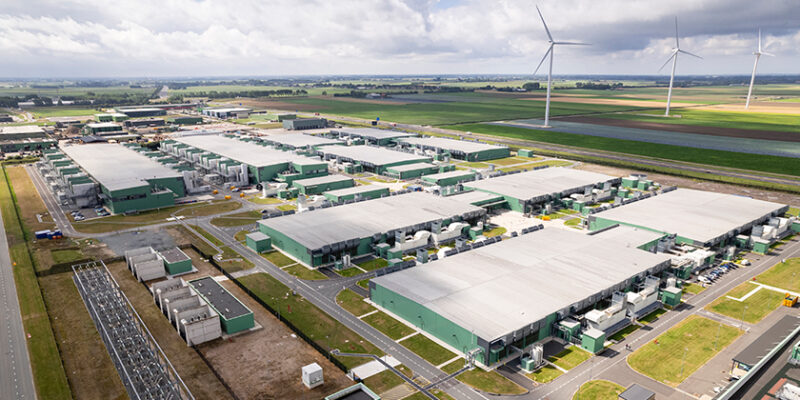
There has been a rise in the co-location of data centres constructed with renewable energy technology, adjoining or located close to the data centre. One prominent example is Microsoft partnering with a renewable energy developer to add renewables capacity to its data centres in the US and Europe. Approximately 560 solar panels have been installed at a data centre in Maidenhead, which is expected to power 12,000 servers and save 96 tonnes of CO2 emissions.
Co-locating a renewable energy infrastructure at a data centre allows for data centres to be built in areas where the grid is not equipped to provide the large loads the data centre requires. Adding renewable energy infrastructure to a data centre site has the benefit of adding efficiency – with less electricity being lost in the transmission process.
The Role of Battery Storage and Hydrogen
Recent improvements to batteries mean that battery storage is increasingly being used at data centres instead of high-carbon backup power sources, to reduce the risks of outages and provide power supply stability. Some data centres in Europe have also been exploring the potential of green hydrogen for energy storage. It is hoped by some that on-site hydrogen generation could allow data centres to operate during grid management or in periods of peak demand, as well as allowing data centres to scale their power supply flexibly. However, hydrogen deployment requires significantly more space than a backup diesel generator or battery storage facility, which may make using hydrogen a challenge on a site with space constraints.
Legal and Operational Considerations
There are many legal and operational factors to consider when co-locating renewable energy with data centres.
- Ownership of renewable energy infrastructure – It is necessary to agree on the ownership of the renewable energy infrastructure
- Maintenance responsibilities – determine the maintenance schedule to avoid any interruptions in energy supply
- Supply-demand management – consider and manage supply-demand imbalances to ensure reliable energy delivery
- Technology ownership – determine who controls the technology and associated rights
- Project timelines – Thoughtful planning needs to be carried out to ensure that the data centre and the renewable energy project schedule for simultaneous operation.
The future of sustainable data centres
If the development of data centres is to be sustainable, there needs to be an increased reliance on renewable energy to power them. The use of power purchase agreements and the co-location of renewable energy at the data centre presents a compelling opportunity to enhance sustainability and ensure regulatory compliance. However, it is essential that any agreements are carefully structured and address the legal and operational complexities involved with integrating renewable energy into data centres. As the demand for data centres continues to grow, embracing renewable energy solutions and innovative agreements like PPAs will be essential to achieving a truly sustainable digital future.
Gillespie Macandrew’s Energy and Strategic Land team understand these complexities, opportunities and challenges involved with integrating renewable energy and infrastructure projects. If you are considering co-location, PPAs or want to explore a potential data centre development, get in touch to see how we can support your project.